| Package import | "zappem.net/pub/graphics/svgpoly" |
|---|---|
| Documentation | https://pkg.go.dev/zappem.net/pub/graphics/svgpoly |
| Sources | https://github.com/tinkerator/svgpoly |
This package supports manipulating a polygon object representation of the content of SVGs. The package is for converting an SVG file input into to a collection of such polygons, and the reverse process.
The primary use case is digesting SVG files from KiCad and automating
the outline generation from overlapping polygons. The package can import
SVGs using svger and
output in SVG format via
svgof.
To be able to run some of the examples, confirm gnuplot is available
on your system. Try:
$ gnuplot --version
If it is missing, install it (Fedora: sudo dnf install gnuplot,
Debian: sudo apt install gnuplot). Then:
$ git clone https://github.com/tinkerator/svgpoly.git
$ cd svgpoly
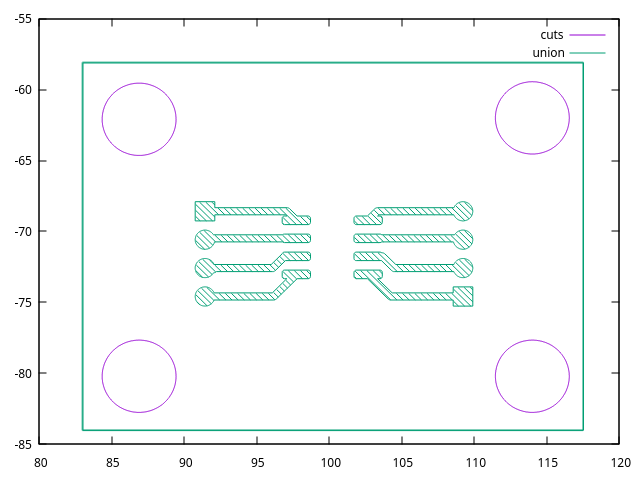
$ go run examples/outline.go --svg examples/test.svg --hatch 0.3 | gnuplot -p
Which should render this processed (union) image:
examples/test.svg but to conform to gnuplot conventions, we’ve
negated the Y axis values relative to the down the page SVG Y axis
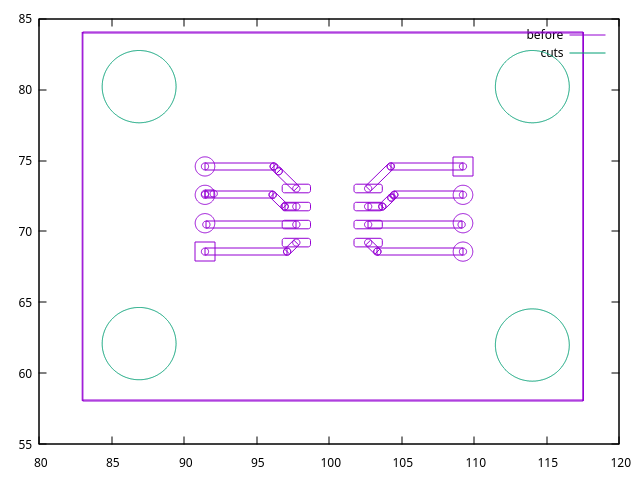
conventions.This example is more faithful to the raw input SVG image in terms of the overlapping polygons.
$ go run examples/outline.go --svg examples/test.svg --before --after=false | gnuplot -p
Which should render this image:
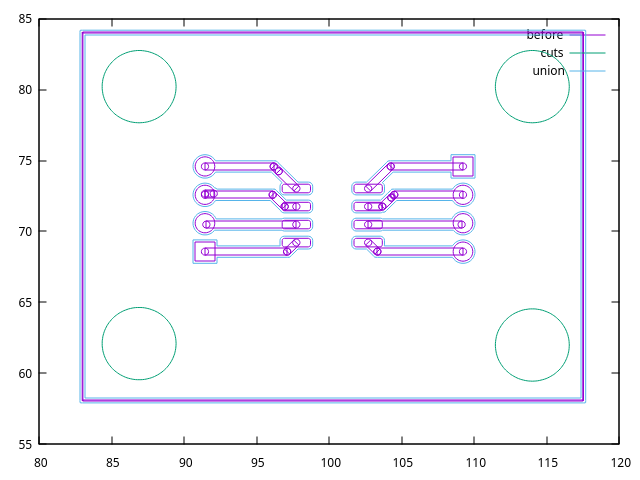
We can inflate the polygons by the value specified with the
--inflate option.
$ go run examples/outline.go --svg examples/test.svg --before --inflate 0.2 | gnuplot -p
Which should render this image:
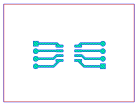
Finally, you can output *polygons.Shapes in the form of an SVG. The
SVG follows the conventions that .Holes appear white and
non-.Holes as blue. A red line is used to identify the outside of a
hole shape (or, said another way, the inner edge of a solid
shape-ring):
$ go run examples/outline.go --svg examples/test.svg --osvg output.svg --hatch 0.3
Which renders as follows:
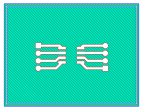
The outline example also supports generating a negative of the
polygons rendered as an SVG or as gnuplot input. To see this, for our
examples/test.svg input, we can do the following:
$ go run examples/outline.go --svg examples/test.svg --osvg negative.svg --hatch .3 --inverse .5 --inflate .1
The outline program can also input and output
polygon.Shapes
in JSON format using the --poly <in.json> and --opoly <out.json>
command line options. This can be useful when debugging polygon
manipulation code.
The example/inflate.go is provided to visualize how the
(*polygon.Shapes).Inflate()
function works. The basic idea is that the outline of the shape is
grown by some distance, and where the resulting outline is to be found
is where lines at that distance intersect. This example program only
outputs in SVG format. A simple invocation of this code is this:
$ go run examples/inflate.go --dest inflate.svg
Which generates three lines (of length 50, 40, 50) where each line’s exterior angle to the next is 30 degrees, it looks like this:
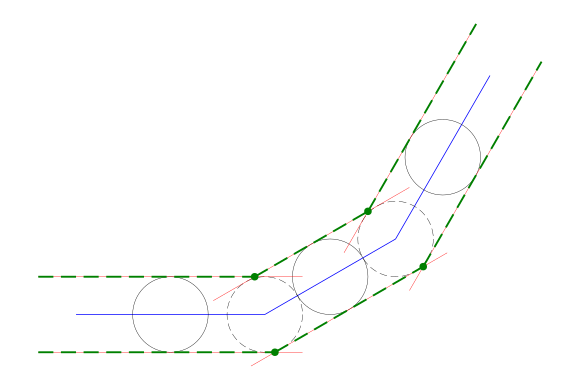
Here, the blue line should be thought of as the three segment section of the original shape’s outline and we are focusing on the inflation around the corner points where three lines connect. The green dashed lines are the outline of the inflated polygon on either side of that original line and the surviving outline corner points are represented as solid green circles. For an actual polygon shape, only one of these two dashed green lines would represent the actual inflation.
What you can see is that these dashed lines are at tangents to circles
of radius --inflate (which defaults to 10) centered on the blue line
with centers at the midpoint and the end points of each line
segment. This first example is the simple case and does not need to
merge any points.
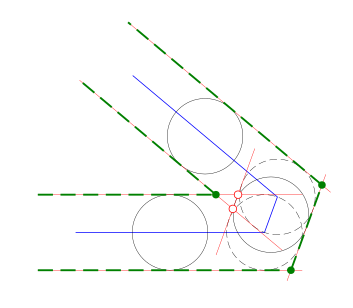
A more complicated example is where the bend at the joins is so tight, it eliminates the simple points (rendered here as empty red circles) in favor of a single merged point (solid green):
$ go run examples/inflate.go --dest tight.svg --alpha 70 --beta 70 --mid 10
Nothing planned.
The svgpoly package is distributed with the same BSD 3-clause
license as that used by
golang itself.
This is a hobby project, so I can’t guarantee a fix, but do use the
github svgpoly bug
tracker.